
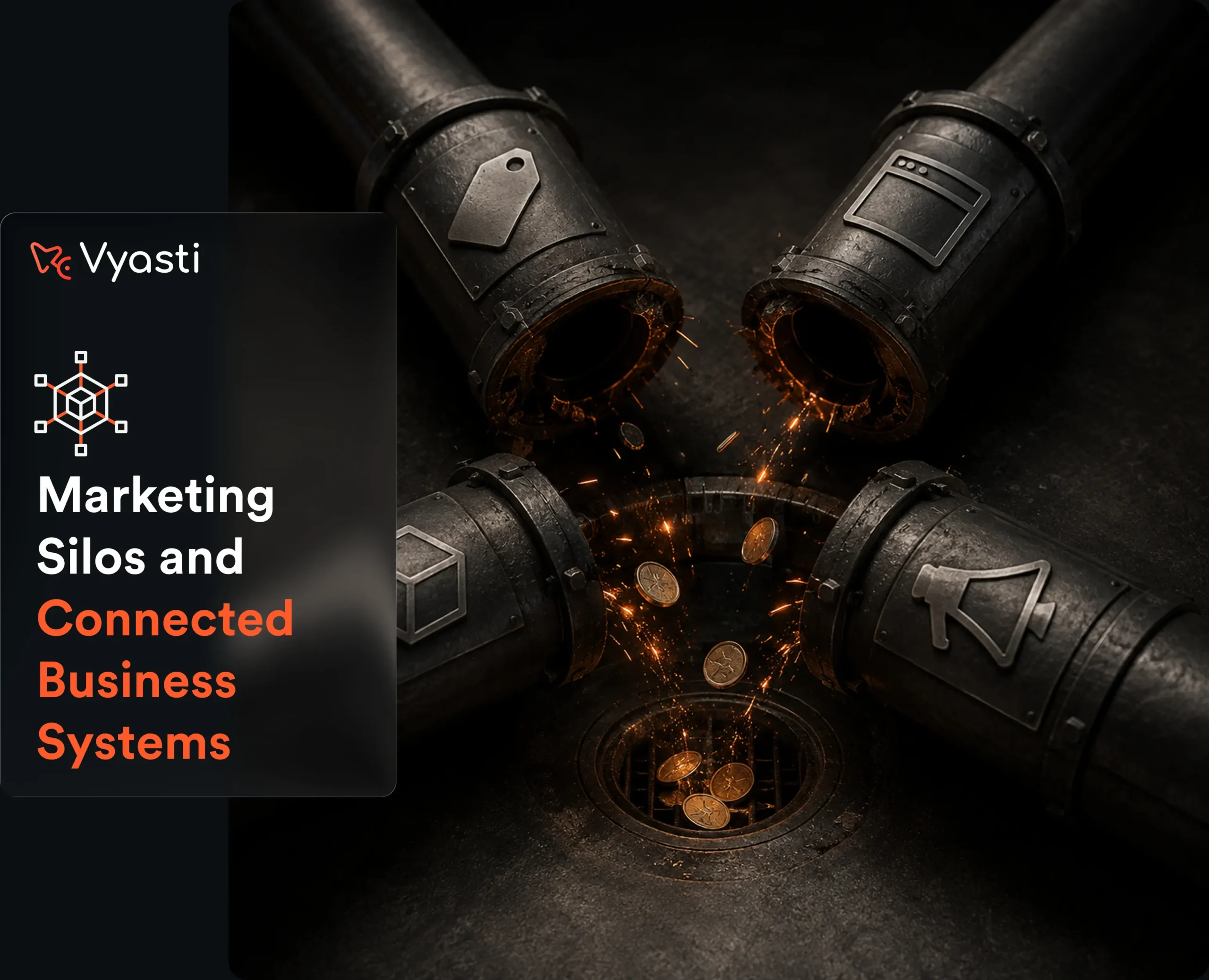
Your customer does not experience your brand, website, product and marketing as four departments. They experience one company.
Inside the business, however, those parts are often run very differently.
The brand team defines one message. The website was built around an earlier version of the business. Product teams create their own terminology. Marketing launches campaigns with another narrative. Sales develops a fifth explanation because the others are not helping enough.
Each team may be doing competent work. Yet together, the business feels fragmented.
This is one of the hidden consequences of marketing silos: the cost is rarely visible as a single invoice. It appears as repeated decisions, inconsistent communication, duplicated assets, slower launches, weaker customer journeys, avoidable redesigns and teams constantly correcting one another’s work.
Eventually, the company spends more effort managing its own inconsistency than building momentum.
Fragmentation creates a tax on every future page, campaign, feature, sales asset and customer interaction the business needs to produce.
Marketing silos are rarely just a marketing problem
Businesses naturally develop specialist functions as they grow. Brand needs its own expertise. Product requires focused ownership. Websites need design and technology. Marketing needs campaigns, content, acquisition and measurement.
Specialisation itself is not the problem.
The problem begins when each function starts making decisions about the same customer experience independently.
Brand
Defines positioning, identity, tone and messaging, but may have limited influence over how those decisions appear in product or campaigns.
Website
Becomes responsible for explaining the business but often operates from old copy, separate briefs and disconnected page decisions.
Product
Evolves features, flows and terminology according to product priorities, sometimes faster than customer-facing communication evolves.
Marketing
Needs results quickly, so campaigns, landing pages and content often develop their own interpretation of the offer.

Your customer does not see your organisational structure
Organisational structures are invisible to customers.
A buyer does not care that brand reports to one leader, product to another and marketing to somebody else. They expect the company to remember what it promised, communicate consistently and make the next interaction feel connected to the previous one.
McKinsey has described this exact challenge in customer journeys: organisations often manage different interaction points through separate functions, while customers expect those touchpoints to behave as one coherent company.
Its analysis of customer-first brands in the digital age argues for thinking in complete customer journeys rather than isolated touchpoints.
That distinction matters.
A campaign can perform well as a campaign while creating expectations the website does not support. A website can look excellent while communicating a value proposition the product does not deliver clearly. The product itself can be strong while the surrounding brand and content make it difficult to understand.
Optimising individual touchpoints does not automatically optimise the journey.
Brand consistency breaks through contradictions, not just colours
Companies often reduce brand consistency to whether teams are using the correct logo, typography and colours.
Those details matter, but strategic inconsistency is more expensive.
“Built for enterprise.”
Generic copy with little enterprise proof.
“Simple, intelligent and effortless.”
Dense workflows and inconsistent terminology.
“This capability changes everything.”
Hide the capability three pages deep.
“Customers care most about this outcome.”
Continue promoting a different benefit.
These contradictions gradually reduce clarity and trust because the customer has to reconcile the business’s story themselves.
A properly built brand system should therefore provide more than visual rules. It should give connected teams a shared foundation for positioning, messages, identity and communication decisions.
The product cannot live outside the brand story
Product teams and brand teams frequently operate at different speeds.
The product evolves through research, user feedback, technical constraints and commercial priorities. Meanwhile, external communication may continue describing an earlier version of what the product does or why it matters.
The gap creates two problems.
First, marketing struggles to explain new capabilities because it was not involved in the underlying product thinking. Second, the product experience may introduce patterns, language and priorities that do not reinforce the broader brand promise.
For digital products especially, the product interface is one of the strongest brand experiences the customer will ever have.
That means product and UI/UX design should not be treated as an isolated screen-production activity. Product structure, customer language, visual behaviour, website explanation and launch communication need enough shared logic to feel like they came from the same business.
Your website often exposes whether the rest of the business is aligned
Website projects have a useful habit of revealing problems that existed before the website project began.
The team needs a homepage headline and discovers that nobody agrees on positioning.
The product page needs evidence, but the business has not documented customer outcomes.
The navigation needs to organise services, but teams use several conflicting service structures.
The case studies need a consistent story, yet project results were never captured systematically.
The CTA needs to send visitors somewhere, but marketing and sales disagree about what qualifies as an appropriate next step.
None of these began as website problems.
A website simply forces the company to make its business logic visible.
This is why effective website and digital experience work has to connect page architecture with positioning, proof, content, customer journeys, conversion and the systems surrounding the site.
Brand and marketing alignment does not mean putting everything in one department
Breaking silos does not require removing specialist teams.
It requires enough shared decisions, systems and feedback loops that each specialist can work independently without pushing the business in a different direction.
Positioning, promise, language, visual system and principles.
Story, customer journeys, proof, conversion and search structure.
Workflows, functionality, product language and user experience.
Campaigns, content, acquisition, landing pages and growth.
The goal is not identical execution. A product interface, website page and campaign should perform different jobs. Integration means they originate from compatible decisions and feed learning back into the same system.
Research on customer-experience operating models makes a similar point. McKinsey argues that dominant functional silos can improve individual processes while still failing to improve the complete end-to-end customer journey. Its operating-model analysis emphasises cross-functional collaboration around customer experience rather than isolated functional optimisation.
What starts happening when the systems connect
Integration creates value differently from a one-off redesign or campaign.
The benefit compounds because one good decision begins supporting multiple outputs.
Teams stop rewriting the business from scratch
Shared positioning and message architecture give website, sales, product and marketing a common starting point.
New outputs become easier to create
Reusable components, principles, content structures and brand rules reduce unnecessary decision-making during every project.
The customer receives one coherent story
Campaign promise, website explanation, product experience and sales communication begin reinforcing rather than contradicting one another.
Insights move across the organisation
Customer questions, conversion data, product behaviour and sales objections begin improving the whole system instead of one channel.
Expansion needs less reinvention
New campaigns, markets, pages, products and assets can extend an existing system rather than creating another disconnected layer.
Teams spend more time improving outcomes
Less capacity is consumed correcting inconsistencies, recreating assets and resolving preventable alignment issues.
This is also why Vyasti’s solution model begins with the business problem rather than assuming that brand, website, content, product or growth should always be solved independently.
How to break marketing silos without creating more meetings
Integration fails when it is interpreted as “everyone must be involved in everything.”
That produces coordination overhead rather than coordination.
A better approach is to decide what must be shared and what can remain specialised.
Create one strategic source of truth
Document the customer, positioning, offer hierarchy, core messages, proof, brand principles and commercial priorities teams should share.
Design around customer journeys
Map how customers move from awareness to evaluation, use and continued engagement instead of assigning responsibility only according to channels.
Share systems, not individual files
Build message frameworks, components, design rules, content templates, product patterns and evidence libraries that can generate multiple outputs.
Connect feedback loops
Product usage should inform marketing. Search behaviour should inform content. Sales objections should inform the website. Campaign response should inform positioning.
Give journeys clear ownership
Someone needs responsibility for the end-to-end result, even when execution crosses several specialist teams.
Review business outcomes together
If every team optimises only its own metrics, the organisation can improve every dashboard while the customer journey remains broken.
Harvard Business Review has similarly argued for cross-functional teams that combine product marketing, sales, service, experience design, development, content and other disciplines around customer purpose rather than channel boundaries. Its discussion of organising around customer purpose provides a useful model for thinking beyond departmental ownership.
This type of work is fundamentally an operating question, which is why Vyasti’s systems-led approach starts by clarifying the business problem and how the required layers need to connect.
Is your business already paying the fragmentation tax?
If several of these are true, the problem may be structural.
Individual projects may keep improving individual assets without fixing the system producing the inconsistency.
Marketing and sales describe your offer differently.
Your website regularly falls behind changes in the product or business.
Every campaign introduces a slightly different visual or verbal system.
Sales has created its own decks because the website does not explain the business properly.
Product terminology is different from website and marketing terminology.
The same design or content problem keeps being solved by different teams.
Customer insights rarely move from one function into another.
Launching something new requires rebuilding supporting assets from scratch.
Stop asking whether each department is producing good work. Ask whether all that good work compounds into one stronger business.
The goal is not integration for its own sake
Brand, website, product and marketing should not become identical disciplines.
They need different expertise, processes and forms of execution.
What they should not have are four unrelated interpretations of the customer, four definitions of the offer and four competing directions for how the company should be experienced.
That is the real issue behind marketing silos.
When businesses connect these systems, they create something more valuable than consistency.
They create compounding.
A positioning decision improves the website and the next campaign. Customer research improves the product and content. Product evidence improves sales communication. Search behaviour reveals customer demand. Campaign learning changes how the website communicates. Stronger proof feeds every channel.
Each piece begins making the others more useful.
This is ultimately the difference between collecting business assets and building a business system.
If your company keeps redesigning, rewriting, rebuilding and realigning the same things, the next project may not need to begin with another deliverable. It may need to begin by identifying why those pieces keep becoming disconnected.
A connected project brief should start with that underlying business problem before deciding whether the answer is brand, website, product, growth, communication or several layers working together.
Questions about marketing silos and connected business systems
What are marketing silos?
Marketing silos occur when teams, channels or functions plan, execute and measure their work separately with limited shared information or coordination. The problem becomes broader when brand, website, product, sales and marketing develop independent messages, systems and customer experiences.
Why are marketing silos bad for customer experience?
Customers experience the company across multiple touchpoints rather than according to its internal departments. When those departments operate separately, customers can encounter conflicting messages, inconsistent terminology, disconnected journeys and repeated information, reducing clarity and trust.
How do marketing silos increase business costs?
Silos can increase duplicated decision-making, content recreation, redesign work, coordination time and maintenance. They can also slow launches and prevent insights from one function improving another, creating both direct rework costs and opportunity costs.
How can brand and marketing alignment be improved?
Brand and marketing alignment improves when teams share positioning, customer understanding, message architecture, proof, visual rules, commercial priorities and feedback loops. The objective is shared strategic foundations while allowing specialists to execute according to their discipline.
Should brand, product and marketing be managed by one team?
Not necessarily. Specialist teams can remain separate. What matters is whether shared customer journeys, strategic decisions, systems, ownership and feedback mechanisms prevent those teams from creating contradictory experiences.
How does a website help connect brand, product and marketing?
The website often sits between customer acquisition, brand communication, product explanation, proof and conversion. Because it touches several functions, it can become a useful connecting layer where shared positioning, content, customer journeys and conversion logic are expressed consistently.